South Korea eSIM in 2026: Data-only vs Korean-number plans for maps, taxis, and reservations

Short answer: choose a data-only eSIM if a reliable internet connection is all you need for navigation, messaging, browsing, and travel apps. Pay for a Korean-number plan only when you have a specific, confirmed need to receive Korean calls or SMS—or when a particular reservation or service has been tested and shown to require one.
The expensive mistake is not choosing the wrong amount of data. It is buying a Korean number because it sounds safer, then finding that the booking, payment, or app flow you cared about has a different requirement. The reverse happens too: a visitor buys a cheap data-only eSIM and discovers late in the trip that a host, clinic, delivery, or reservation service needs to reach them by a local number.
This guide separates those two jobs so you can buy the smallest plan that solves the real problem.
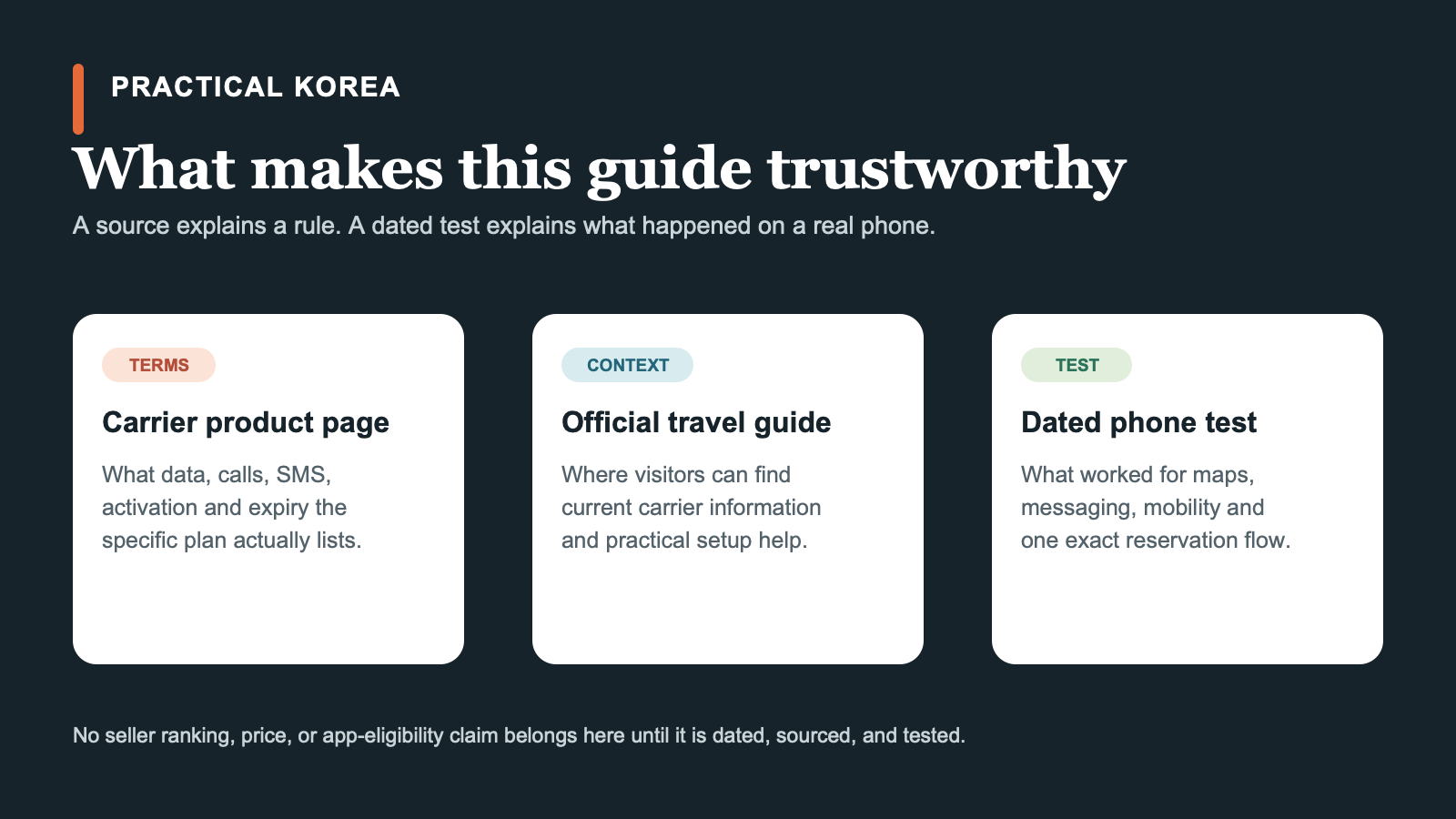
How this guide is made: this is a source-backed decision guide, not a ranking of eSIM sellers. It does not claim a personal field test that has not yet been completed. Product terms, app eligibility, identity checks, and payment support must be rechecked immediately before publication and whenever a provider changes its terms.
Start with the question that changes the answer
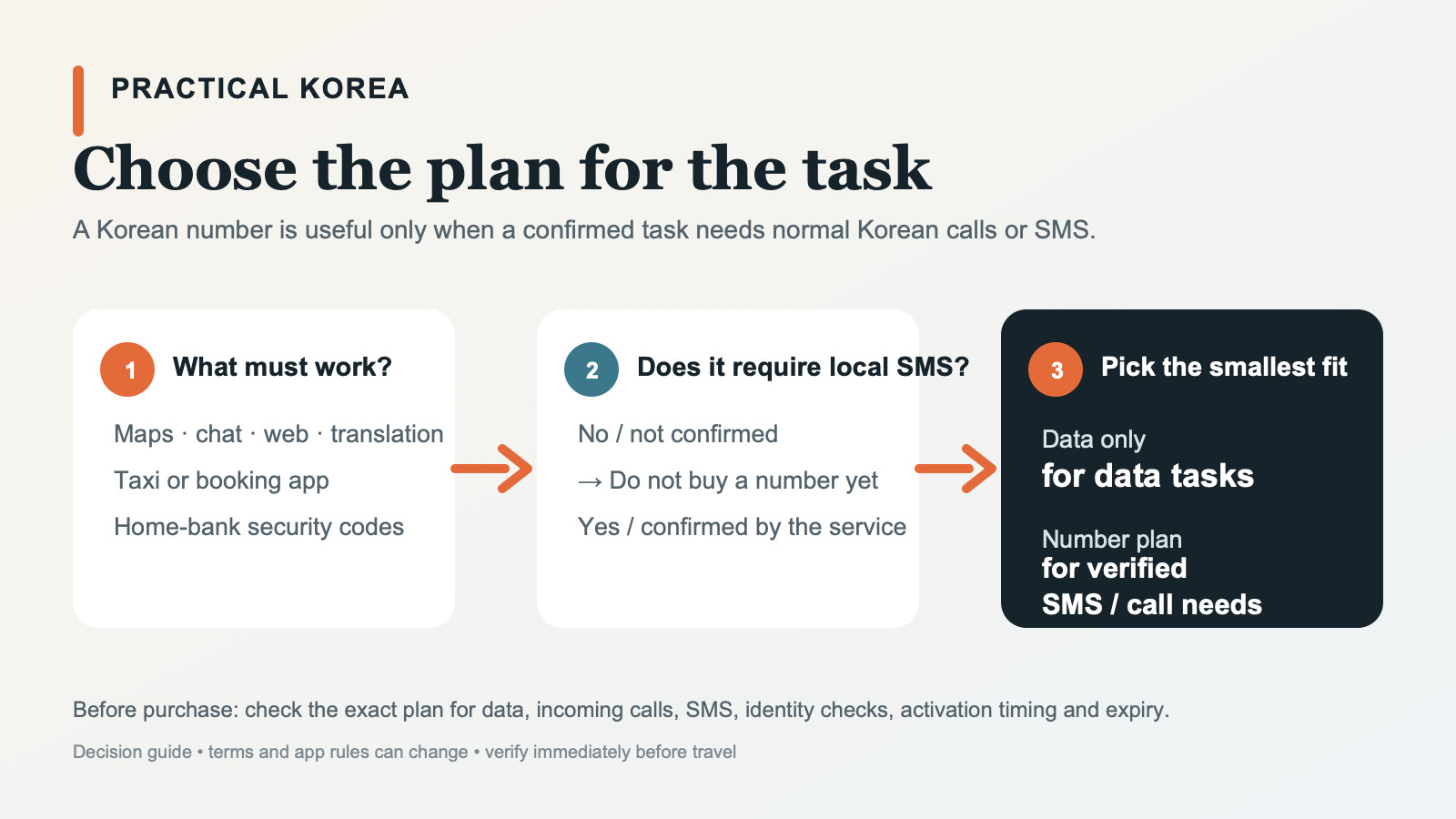
A data connection and a Korean phone number are different products.
- Data-only eSIM: gives the phone mobile internet. It is usually enough for web browsing, map data, messaging apps, translation, and any travel service that accepts an account and payment method you can already use.
- Korean-number plan: gives a local number only if the specific product includes voice/SMS service and you complete its requirements. It may let you receive calls or texts, but it does not automatically make every app, booking site, payment method, or identity check work.
For example, KT’s tourist eSIM page distinguishes its Data eSIM as data only from options that include call/SMS functions. The same page says that its voice/SMS use requires an in-person identity/entry check at a KT roaming center. Treat that as a product-specific example, not as a rule for every seller. Check KT’s current eSIM terms before buying.
The useful decision is therefore not “Which eSIM is best?” It is: Will any task on this trip fail if I cannot receive a normal Korean call or SMS?
The practical decision table
| Your situation | Start with | Why | What to confirm before you pay |
|---|---|---|---|
| You need maps, chat, browser access, translation, and email | Data-only eSIM | These tasks depend on mobile data, not on owning a Korean number. | Your phone is unlocked and eSIM-compatible; the map and messaging apps work on data. |
| You need a taxi option designed for international visitors | Data-only eSIM, then test the exact app | A Korean number should not be your first assumption. Kakao describes K.ride as its international-user mobility app, but availability and payment eligibility are service rules that can change. | Install the app, confirm account creation, an accepted payment method, and a test route before relying on it. |
| A hotel, host, employer, clinic, or local contact must be able to call or text you on a Korean number | Korean-number plan | You have an explicit communication need that data alone does not cover. | The plan includes inbound voice/SMS, the activation/identity step, duration, and any recharge rule. |
| You expect to book restaurants, tickets, classes, or local services | Data-only first unless the exact service says otherwise | Booking flows differ: some accept email or a foreign number; others may ask for Korean SMS verification. | Check the exact booking page and complete a test reservation before upgrading your plan for this reason alone. |
| Your home number receives bank, work, or two-factor codes | Keep your home SIM active if your carrier and phone support it | A Korean number is not a replacement for codes sent to your existing number. | Dual-SIM behavior, roaming charges for receiving texts/calls, and which line handles mobile data. |
| You are staying long term or need resident-level services | Investigate a regular local mobile plan, not a tourist eSIM by default | Tourist products are designed for short stays and can have different eligibility and renewal limits. | Residency/identity requirements, contract term, and whether the service is intended for your length of stay. |
What data-only usually solves well
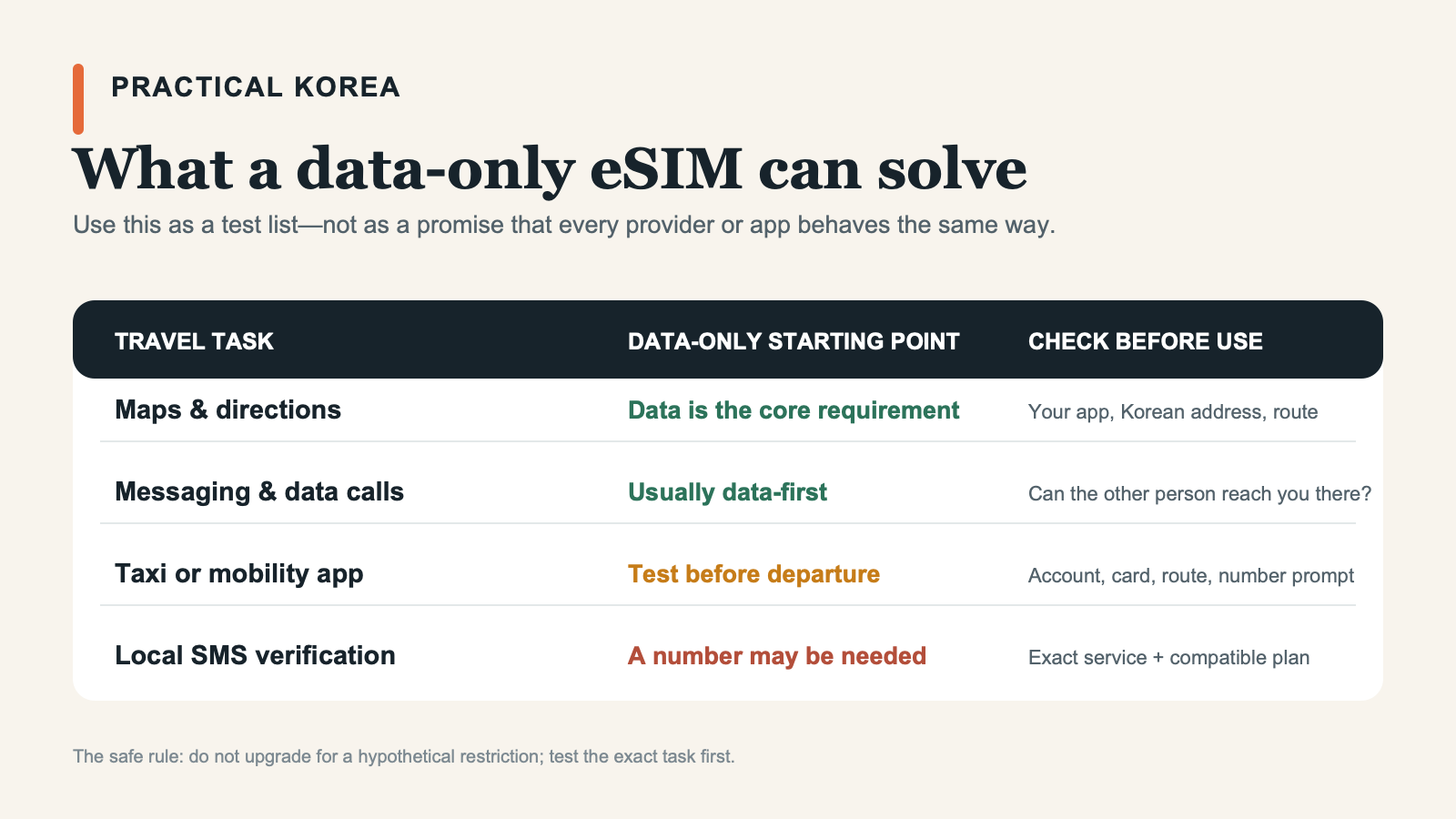
For many short trips, mobile data is the actual bottleneck. Once the phone has data, you can use online maps, save addresses, message a host, call through a data-based app, translate signs, check opening times, and access booking confirmations already tied to your email.
That does not mean every travel task is solved. It means you should test the task before adding the cost and setup friction of a local number.
Maps
Choose an app before you land, sign in if it needs an account, save your accommodation in two formats (English and Korean), and test a route on mobile data. The underlying requirement is connectivity, so a data-only eSIM can be enough.
Keep a screenshot of the Korean address and the nearest station. This is more useful than a number plan when you need to show a driver or ask for directions with limited signal.
Messaging and data calls
If your host, friends, or workplace already use a messaging app, a data-only plan can support messages and in-app voice/video calls. Confirm the other party can reach you there; do not assume a local contact will switch to a particular app after you arrive.
Taxi and mobility apps
Do not buy a Korean number solely because you expect to use a taxi app. Kakao has described K.ride as its mobility app for international users, with English, Simplified Chinese, Traditional Chinese, and Japanese support in its October 2025 travel information. That page is useful context, but it is not a permanent statement of current account, card, or service-area eligibility. Read Kakao’s original notice.
Before travel, install the current app and verify all four steps on your own phone:
- Can you create or sign in to an account?
- Can you add the payment method you intend to use?
- Does the app show a route from your arrival area to your accommodation?
- Does it ask for a Korean number at any point?
If the answer to the last question is yes, record the screen and check the app’s current help center before changing your connectivity plan. A number plan only helps if that product can receive the required text and the app accepts the number type.
When a Korean number is worth the extra work
Buy a Korean-number plan when the need is concrete rather than hypothetical. Good reasons include:
- A host, local workplace, school, clinic, or tour operator will contact you by Korean call or SMS.
- You have checked a particular booking flow and it requires a Korean SMS verification that your current number cannot complete.
- You need to receive local callbacks during a stay where data-based messaging is not an agreed alternative.
Before buying, read the product page for the exact words data, incoming calls, outgoing calls, SMS, identity verification, activation, top-up, and expiry. A plan marketed as “tourist SIM” may still be data only. A number-bearing product may require airport pickup or an in-person identity check before calls and texts work. The Korea Tourism Organization likewise notes that visitors can buy prepaid options for data or a personal number, and directs travelers to carrier roaming centers for current details. See VISITKOREA’s mobile communications guidance.
A Korean number is not a universal unlock key
Avoid three common assumptions:
- “A number plan will make every local app work.” App registration, payment, nationality, ID, and service-area rules can be separate checks.
- “Any tourist number can receive every verification text.” Confirm the plan’s SMS capability and test the exact service; do not rely on the product name.
- “I can sort it out after deleting the eSIM.” Some providers limit installation or reissue of an eSIM QR code. Keep the installed profile and the purchase record until the trip is over, and follow the provider’s own reinstallation policy.
A low-risk setup before departure
Do this while you still have dependable Wi-Fi and access to your home number.
- Check the phone, not just the plan. Confirm your exact model supports eSIM, is carrier-unlocked, and can keep your home SIM active if you need two-factor codes.
- Write down your must-not-fail tasks. For example: “find the hotel,” “message the host,” “get from the airport,” and “make one restaurant reservation.” A plan should be chosen against this list.
- Install only when the seller’s timing rules allow it. Save the order number and QR instructions securely. Do not publish the QR code in a screenshot or a review.
- Label the lines clearly. Set the travel eSIM for mobile data and keep the home line available only where you need it. Check your phone’s roaming and data-switching settings carefully; the correct choices vary by device and carrier.
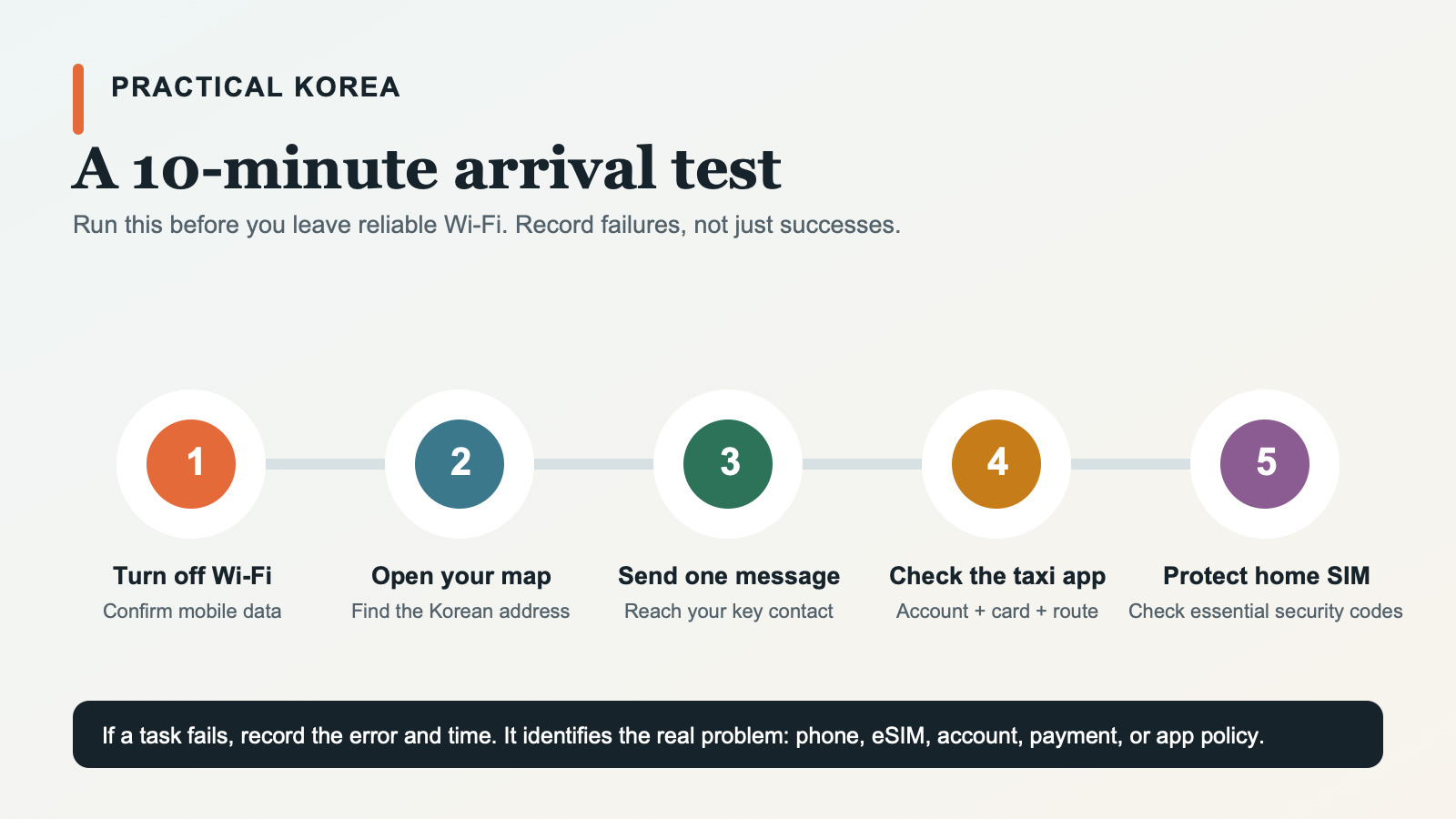
- Test on arrival before leaving reliable Wi-Fi. Open a map, send a message, load the taxi app, and verify that your home number can still receive the essential code or message.
If any step fails, save the error message and time. That record is more useful than repeatedly buying a new plan: it tells you whether the problem is the phone, installation, account, payment method, or an app rule.
A 10-minute arrival test
Run this test at the airport, accommodation, or another location with Wi-Fi as a fallback:
- Turn off Wi-Fi briefly and confirm the travel eSIM carries mobile data.
- Open your map app and search for your accommodation by its Korean address.
- Send one message to the person most likely to need you.
- Open the taxi/mobility app and confirm its sign-in and payment state without placing an unnecessary order.
- Try the exact booking service that motivated the Korean-number question, if one exists.
- Confirm that your home line still receives any critical two-factor code without unexpected roaming charges.
Write down what happened, including failures. The article should eventually tell readers which tasks were tested, on which device, with which plan type, and on what date—not present a generic “it worked” claim.
My recommendation by traveler type
Short-stay visitor with a normal hotel and card: start with data-only. Have an international-friendly taxi option and a backup payment method ready, but do not add a number merely out of anxiety.
Visitor with a confirmed local SMS/call requirement: choose a number-inclusive option after confirming that its voice/SMS and activation requirements match your arrival plan.
Remote worker, student, or longer-stay newcomer: list the exact services you need in the first week. If the list includes regular Korean calls, local verification, or resident services, compare a proper long-stay mobile option rather than repeatedly extending a tourist product.
Anyone dependent on a home bank or work login: protect the home number first. A travel eSIM is for connectivity; it should not disrupt the line that receives your security codes.
Frequently asked questions
Can I use maps in Korea with a data-only eSIM?
Yes, if the map app can access the internet and you have set it up successfully on your phone. Save key addresses in Korean as a backup. The important test is your own phone and the current app—not whether the eSIM includes a Korean number.
Do I need a Korean phone number for taxis?
Not automatically. Kakao positions K.ride for international users, but account and payment rules can change. Test the current app flow with your intended card and route before you travel; do not treat an old blog post or a product page as proof that your account will be eligible.
Do I need a Korean phone number for restaurant reservations?
Sometimes a specific booking system may ask for one, but that is not a reason to buy one blindly. Check the venue’s actual booking route: email confirmation, foreign-number format, payment, and SMS verification are separate questions.
Is a physical SIM better than an eSIM?
Choose the format your device supports and that you can activate reliably. The more important comparison is still data-only versus number-inclusive service. A physical SIM can be useful as a fallback for a device without eSIM support; an eSIM can be convenient because it avoids swapping a card. Neither format guarantees a local number or app eligibility.
Should I buy the biggest “unlimited” plan?
Check the provider’s current fair-use, speed, hotspot, duration, and top-up terms instead of relying on the word “unlimited.” This draft intentionally does not compare prices or speeds because those details change frequently and require a dated product-by-product review.
How we will keep this guide current
This guide does not present unperformed testing as fact. Because plan terms and app rules change, we will add a transparent field-test note when the following checks have been completed:
- device model, operating-system version, home-country carrier, and whether the device was unlocked;
- provider/product name, plan type, activation date, and purchase/activation channel;
- whether data worked after Wi-Fi was disabled;
- the map, messaging, taxi, and one reservation test result, including any failure point;
- whether a Korean number was issued and whether inbound SMS/calls were actually tested;
- updated screenshots with personal data, QR codes, booking codes, phone numbers, and payment details removed.
Do not add seller rankings, “best eSIM” language, affiliate links, prices, or claims that a specific app works without a Korean number until those facts have been personally tested and dated. If an affiliate relationship is added later, place a clear disclosure before the first recommendation.
Sources and update log
All sources below were checked on 2026-07-16. They support only the limited facts stated here; traveler-app eligibility and carrier plan terms are change-sensitive.
- KT Roaming — tourist eSIM product page: product-specific distinction between data-only and voice/SMS-capable eSIM options; review again before naming or recommending a plan.
- Korea Tourism Organization / VISITKOREA — Electricity & Communications: official traveler guidance on roaming centers, SIM/eSIM availability, and the distinction between data access and a personal number.
- Kakao — “Kakao Travel Pack” for International Tourists: source for K.ride’s international-user positioning and listed language support. Its campaign dates were in 2025, so use it as background only and verify the live app experience before publication.
Planned internal links
- Next: Incheon Airport to Seoul: AREX vs airport bus vs taxi by arrival time, hotel, and luggage.
- Related: Kakao T vs Uber in Korea for foreign cards: what to check before landing.
- Related: Google Maps in Korea: when to use Naver Map or KakaoMap instead.