
T-money vs NAMANE vs WOWPASS: Which Korea Travel Card Should You Buy?
Last checked 2 August 2026. This is a source-based planning guide using official card-provider and public-tourism information, not a personal card-use test. Prices, exchange rates, fees, machine locations and acceptance can change—check the linked official pages before paying.
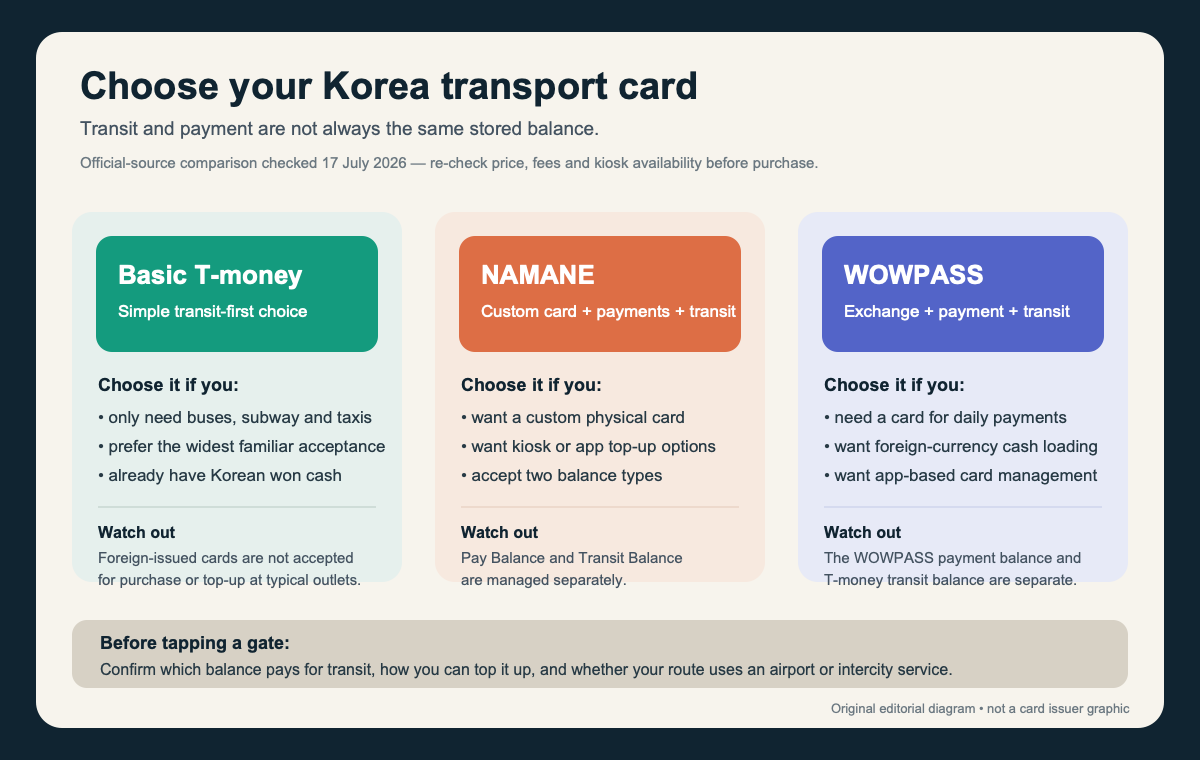
Original decision guide. The crucial distinction is the balance you tap for transit: it may not be the same balance you use to pay in shops.
If you want one straightforward answer: choose a basic T-money card when you only need public transport and have Korean won cash. Choose NAMANE if you want a customizable physical card with payment and transit functions. Choose WOWPASS if you also want a tourist payment and currency-loading card.
All three can help with everyday buses and subways, but they do not work in the same way. The most common first-day mistake is assuming that money loaded for shopping will automatically pay a subway or bus fare. For both NAMANE and WOWPASS, the transit balance is separate from the payment balance.
Quick comparison
| Card | Best for | Card cost shown by official sources | How it handles transit | Important limitation |
|---|---|---|---|---|
| Basic T-money | Transit-only visitors with Korean won cash | KRW 3,000–5,000 for a general card | One stored-value transit card for participating buses, subways and many taxis | Korea Tourism Organization’s 2026 payment guide says foreign-issued cards are not accepted for typical purchase or top-up; prepare cash. |
| NAMANE | Visitors who want a custom card plus payments and transit | KRW 7,000 for a standard custom kiosk card | Transit Balance is used by tapping; Pay Balance is used for chip payments | The balances are separate. Some app top-ups require tapping the physical card to a compatible phone. |
| WOWPASS | Visitors who also need payment and currency-loading tools | KRW 5,000 shown on the current official guide | A separate T-money transportation balance is tapped for transit | Loading the WOWPASS spending balance does not automatically load the T-money balance. |
The card price is separate from the money you add for transport or purchases. Promotions and designs can affect what you see at a kiosk.
2 August 2026 source check: Korea Tourism Organization’s current visitor payment guide still says foreign-issued cards are not accepted for ordinary prepaid T-money purchase or top-up. NAMANE’s current manual still separates Pay Balance and Transit Balance; WOWPASS’s current guide still requires a separate T-money top-up. Seoul’s current Climate Card page confirms that international credit/debit cards can be used for short-term passes. These are provider rules, not a promise that a particular kiosk, card, or route will work for every traveler.
First, choose based on the problem you need to solve
1. “I only need buses, subway and an occasional taxi.” — Basic T-money
A regular T-money card is the low-complexity choice. Korea Tourism Organization says T-money cards are sold at convenience stores nationwide and at designated Seoul subway service locations, and they can be reloaded at subway ticket vending machines. The same guide describes public-transport and T-money-logo merchant acceptance.
The practical catch for an international arrival is payment method: the Korea Tourism Organization’s May 2026 transport-payment guide says foreign-issued credit cards are not accepted for prepaid T-money purchase or top-up; it labels this workflow as cash only. Have Korean won available before relying on it.
Choose this route if you do not need currency exchange or an app-based travel wallet. It is also the easiest option to explain at a convenience store: show the card and say, “T-money charge, please.”
2. “I want a card I can use for shops as well as transit.” — NAMANE
NAMANE combines a prepaid payment function and the Rail+ transit service. The provider calls its two wallets Pay Balance and Transit Balance:
- Use Pay Balance by inserting the IC chip at supported in-person merchants.
- Use Transit Balance by tapping for public transport.
NAMANE’s English instructions say that a standard custom card costs KRW 7,000 at a kiosk and can be purchased with cash or domestic/international debit or credit cards. It also lists kiosks at airports, stations and major visitor districts—so check the live kiosk map rather than assuming every terminal or station has one.
The setup warning matters: topping up one balance does not necessarily fund the other. NAMANE’s app instructions state that topping up Transit Balance with an international card requires the physical card to be tapped to the phone. If you are only carrying an iPhone or a phone without NFC, use a kiosk or cash alternative after checking the current instructions.
Choose NAMANE if the personalized design, app controls and combined payment/transit concept are more valuable to you than the simplicity of a basic transit card.
3. “I need a payment card and I may load foreign cash.” — WOWPASS
WOWPASS is built around a travel-payment card and also includes a T-money transit function. Its official English guide says:
- Insert the card’s IC chip for eligible local card payments.
- Tap the card at a public-transport terminal for the T-money transportation balance.
- Top up the T-money transportation balance separately from the WOWPASS spending balance.
The WOWPASS site currently describes cash loading in 16 currencies, mobile loading via international cards or e-wallets, payment-history tools, and machine locations. The Korea Tourism Organization’s card guide lists a KRW 5,000 card price and advises activation after purchase. Check the live machine map and the displayed exchange rate and fees before you insert cash or make a reservation.
Choose WOWPASS if your trip also needs a Korea payment method and you prefer a tourist-oriented app and machine network. Do not choose it solely to avoid thinking about transit top-up: you still need to make sure the T-money balance has enough money before entering a gate or boarding a bus.
A visual source check: the 2026 visitor payment guide
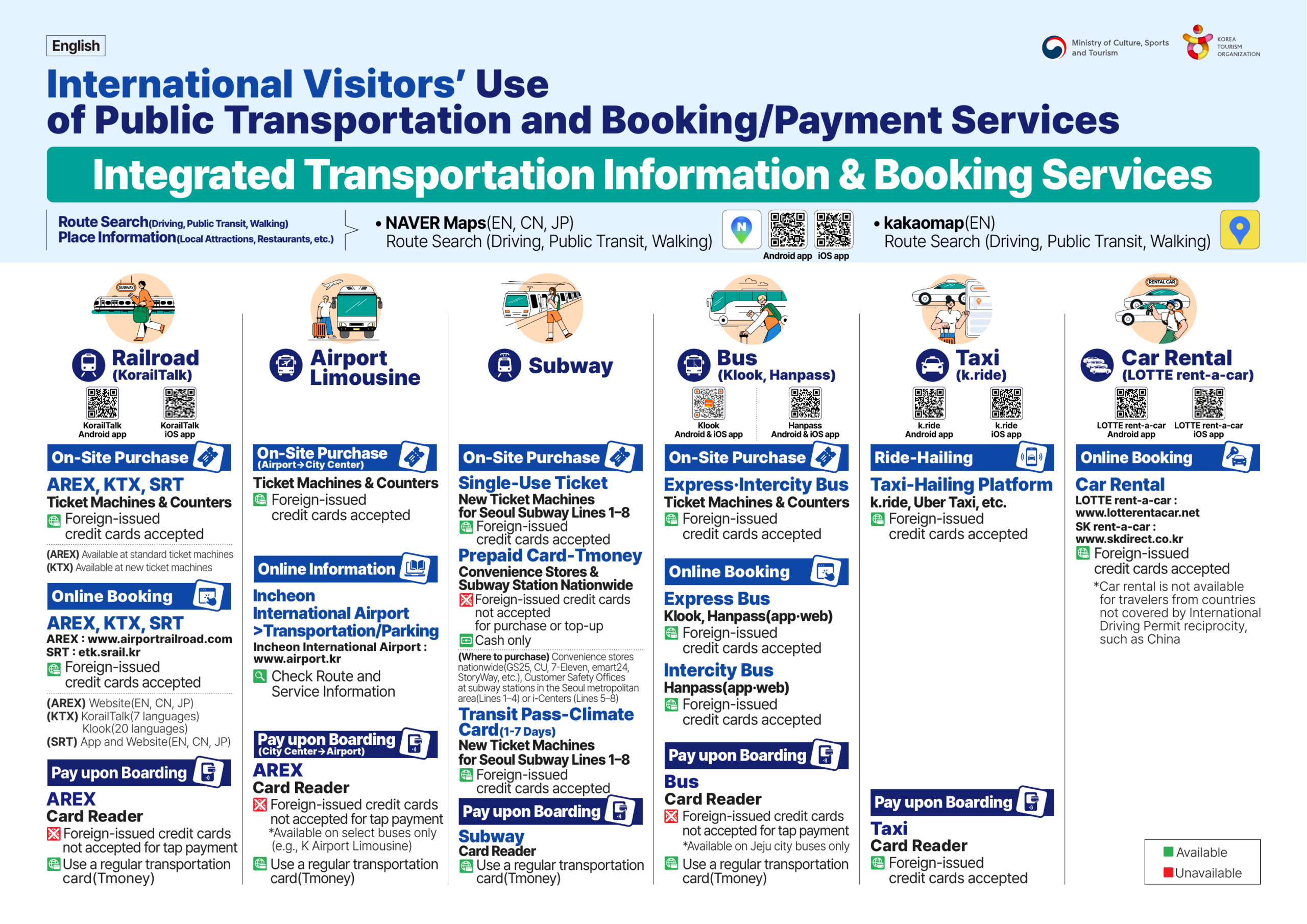
Screenshot: Korea Tourism Organization, “International Visitors’ Use of Public Transportation and Booking/Payment Services,” captured 17 July 2026. English explanation: its prepaid T-money row says foreign-issued cards are not accepted for purchase or top-up and labels the method cash only. The page is a source screenshot, not a record of a personal purchase or trip.
This is useful when you land without Korean won. It also means that a single-use subway ticket, a travel card and an airport-ticket workflow can have different payment rules. Do not assume that a foreign card accepted at one ticket machine will be accepted by every card charger or on a bus tap reader.
Do you actually need the Climate Card instead?
For heavy, short-term travel inside Seoul, the Climate Card can be a separate fourth option. Seoul lists short-term passes at KRW 5,000 for one day, KRW 8,000 for two days, KRW 10,000 for three days, KRW 15,000 for five days and KRW 20,000 for seven days; the physical card costs KRW 3,000 separately.
It is not a universal Korea pass. The Seoul Metropolitan Government excludes airport buses, intercity buses, the Sinbundang Line and subway travel outside the service area. On AREX, it says riders may get off at Incheon Airport Terminal 1 or Terminal 2 but cannot board there using the Climate Card. Check your hotel area and planned routes before buying a pass just because it looks cheaper.
A first-day setup that avoids a transit-balance surprise
- Decide whether you need transit only or transit plus a Korea payment card.
- If you choose basic T-money, get Korean won first and confirm the shop can sell and charge it.
- If you choose NAMANE, identify the Pay Balance and Transit Balance screens before loading money.
- If you choose WOWPASS, load the T-money transportation balance separately before your first subway or bus ride.
- Tap on and tap off when using buses or the subway. Korea Tourism Organization notes that the transfer benefit depends on tapping out; transfer windows and rules vary by city.
- Keep enough balance for the next ride and re-check the official card or kiosk instructions if your arrival is late, your card is lost, or a machine is unavailable.
What to re-check on the day you buy
- Card issue price and any promotional design price
- Kiosk or machine location and operating hours
- Current foreign-card and mobile-wallet top-up methods
- Exchange rate, withdrawal amount and any loading or withdrawal fee
- Which balance pays for transit
- Whether your first trip is an airport/intercity service with different rules
Official sources and update log
- Korea Tourism Organization: International Visitors’ Use of Public Transportation and Booking/Payment Services — checked again 2 August 2026
- Korea Tourism Organization: Transportation Cards — checked again 2 August 2026; treat prices and availability as items to re-check
- T-money English site
- NAMANE: card information and balance types
- NAMANE: kiosk purchase instructions
- NAMANE: international-card top-up instructions
- WOWPASS: How to Use
- WOWPASS official site and machine map
- Seoul Metropolitan Government: Climate Card — checked again 2 August 2026
For a related arrival task, read our Incheon Airport to Seoul transport comparison after checking your exact hotel address and arrival time.
